leadership
leadership
design leadership
design leadership
|
|
design Team strategy
strategy
|
|
Growth
Growth
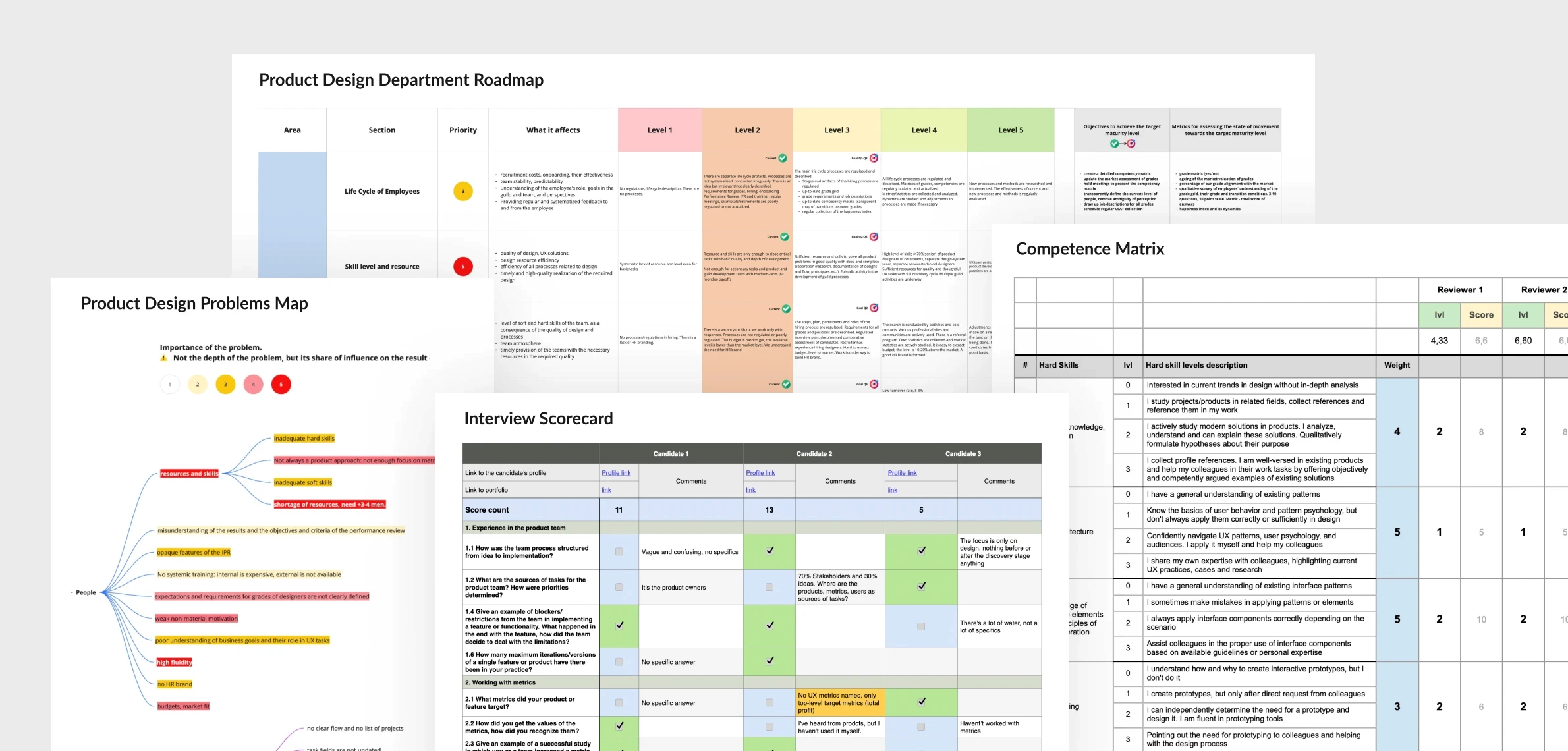
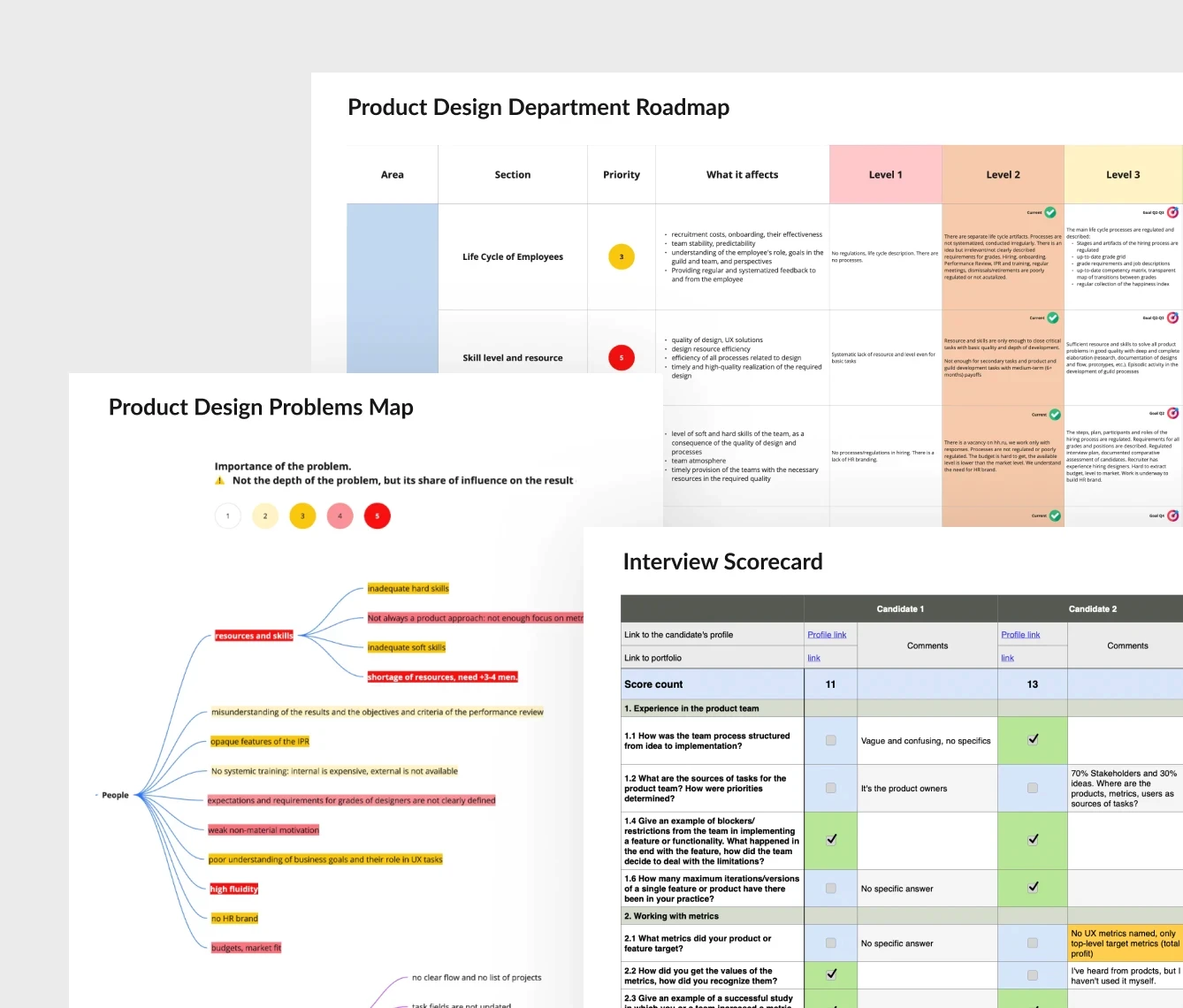
To date, my leadership experience spans 7 various design teams, while I remain a hands-on playing coach for the most challenging design work.
To date, my leadership experience spans 7 various design teams, while I remain a hands-on playing coach for the most challenging design work.
I built 4 design teams from scratch. I’m proud of their achievements and enjoyed working with those talented designers. I’ve also joined teams at various maturity stages as their lead.
Each team is unique, and every management approach depends on specific company factors. As a problem solver, I always ask business stakeholders the same questions I use in design work: “What is the problem?” and “What do we want to achieve?” The answers shape the strategy, tools, and future team structure.
I built 4 design teams from scratch. I’m proud of their achievements and enjoyed working with those talented designers. I’ve also joined teams at various maturity stages as their lead.
Each team is unique, and every management approach depends on specific company factors. As a problem solver, I always ask business stakeholders the same questions I use in design work: “What is the problem?” and “What do we want to achieve?” The answers shape the strategy, tools, and future team structure.
problem
problem
The same approach as in UX can definitely be applied to team leadership. First, we need to define what we want to achieve with a new team or what problems we want to solve in an existing one.
The same approach as in UX can definitely be applied to team leadership. First, we need to define what we want to achieve with a new team or what problems we want to solve in an existing one.
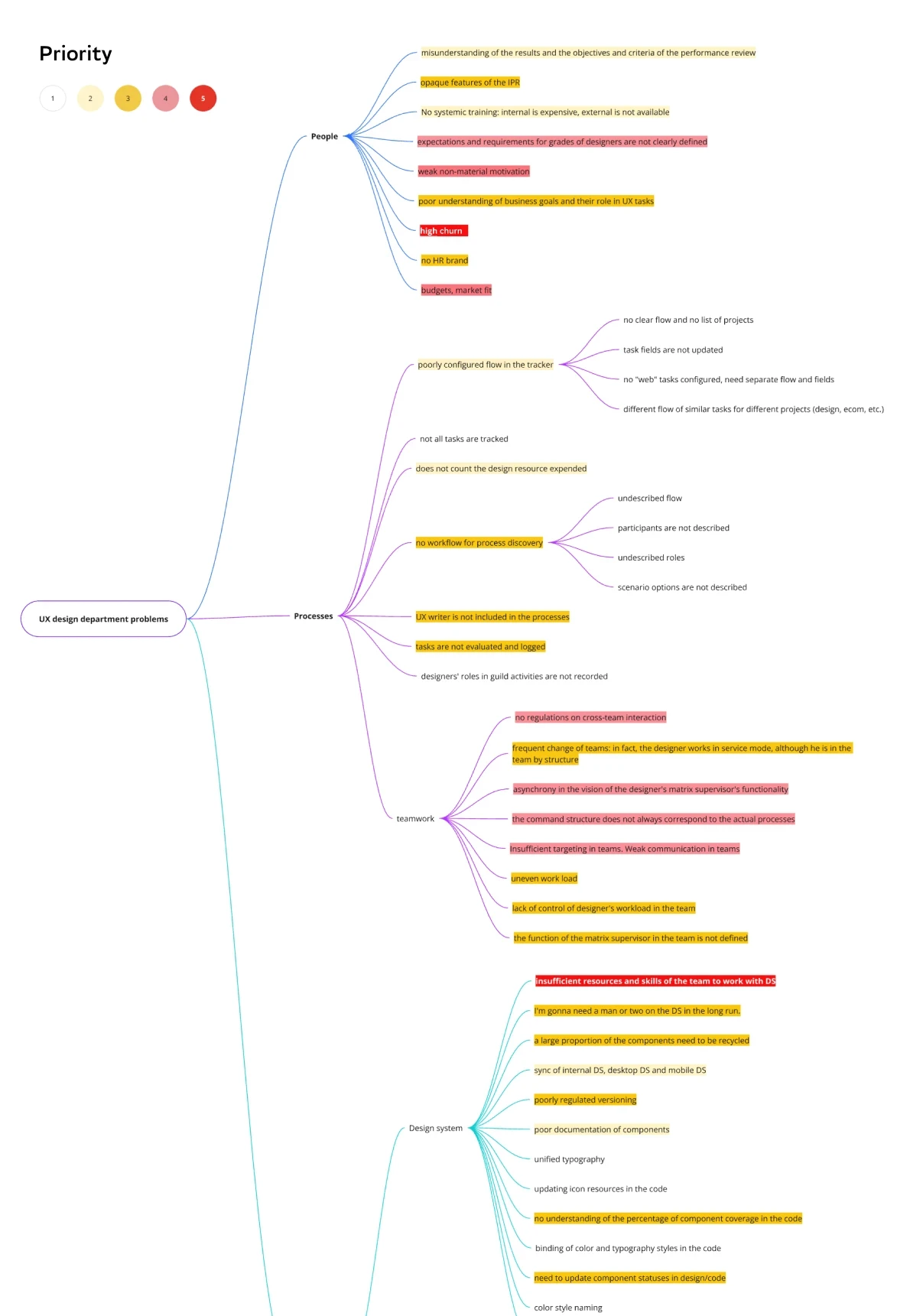
A problem map can help with that. It may seem simple, but this step is highly effective: it often reveals hidden issues or, conversely, exposes “big” problems that do not actually exist.
The map is divided into three branches: people, technology, and processes. Priority is added as a separate dimension, giving each problem a certain weight and helping highlight what needs attention first.
A problem map can help with that. It may seem simple, but this step is highly effective: it often reveals hidden issues or, conversely, exposes “big” problems that do not actually exist.
The map is divided into three branches: people, technology, and processes. Priority is added as a separate dimension, giving each problem a certain weight and helping highlight what needs attention first.
Strategy
Strategy
Design roadmap brings together design team growth, business impact, strategy, and processes that influence design team and entire project.
Design roadmap brings together design team growth, business impact, strategy, and processes that influence design team and entire project.
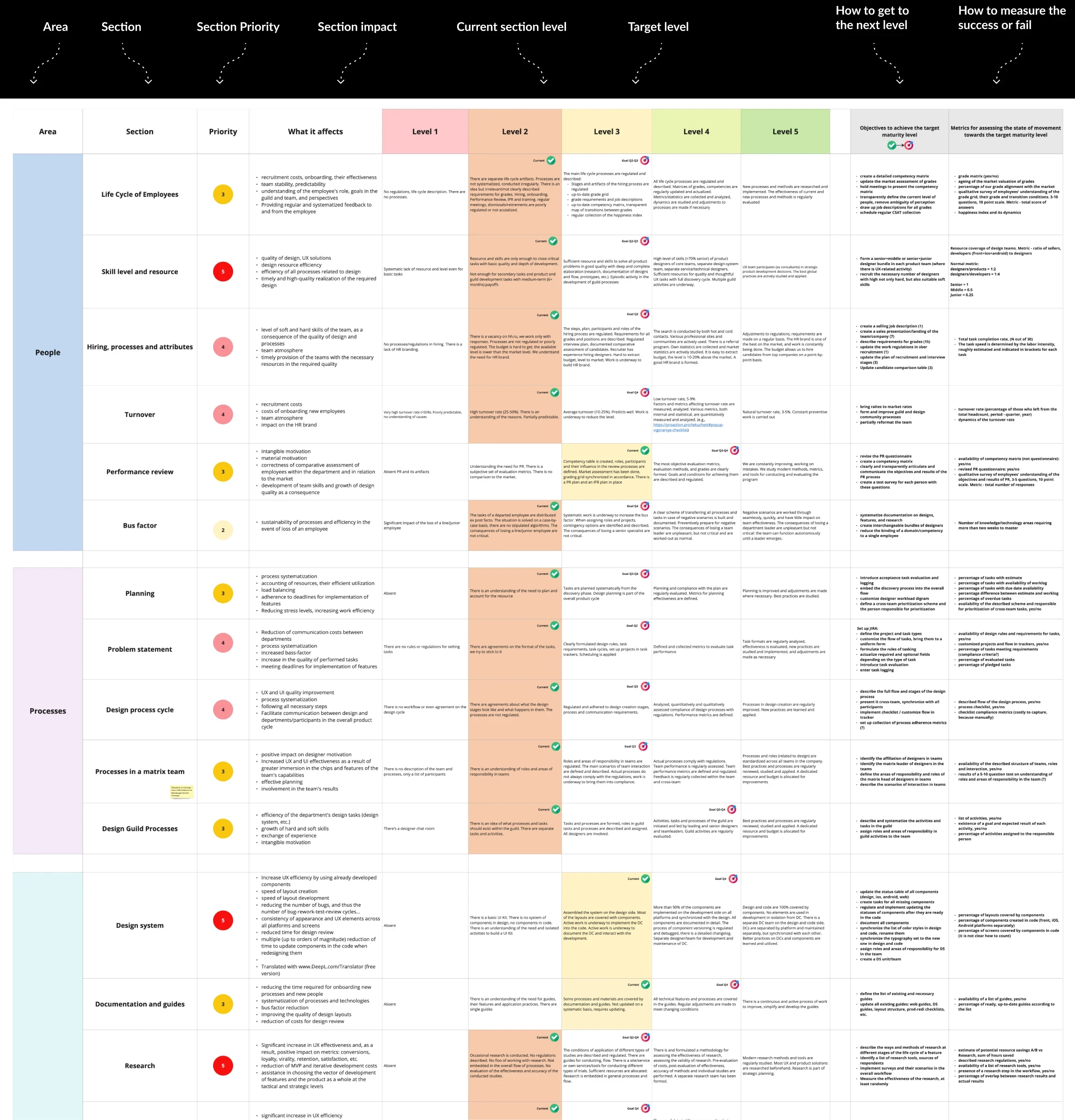
The roadmap can be divided into three areas: people, technology, and processes. Each area has its own list of sections, which in turn includes descriptions of priority, impact, maturity levels, and specific actions required to advance to the next level, complete with measurable metrics or results.
This serves as a foundation and guide for the strategic roadmap, enabling the design team to build and follow a clear path for evolution. However, to apply this approach effectively, the company’s overall maturity and product stage must reach a certain level.
The roadmap can be divided into three areas: people, technology, and processes. Each area has its own list of sections, which in turn includes descriptions of priority, impact, maturity levels, and specific actions required to advance to the next level, complete with measurable metrics or results.
This serves as a foundation and guide for the strategic roadmap, enabling the design team to build and follow a clear path for evolution. However, to apply this approach effectively, the company’s overall maturity and product stage must reach a certain level.
evaluation
evaluation
Evaluating design team and design skills is one of the most challenging and controversial topics.
Evaluating design team and design skills is one of the most challenging and controversial topics.
How do we introduce objective metrics into often subjective assessments?
While 100% objectivity is impossible, we can significantly reduce subjectivity and establish a transparent methodology. There are a few tricks that make evaluation clear, objective, and business-oriented.
How do we introduce objective metrics into often subjective assessments?
While 100% objectivity is impossible, we can significantly reduce subjectivity and establish a transparent methodology. There are a few tricks that make evaluation clear, objective, and business-oriented.
How do we introduce objective metrics into often subjective assessments? Competence matrix.
While 100% objectivity is impossible, we can significantly reduce subjectivity and establish a transparent methodology. There are a few tricks that make evaluation clear, objective, and business-oriented.
Score & Weighting
Score & Weighting
The competency matrix has two sections: hard skills and soft skills. The first trick is to fill these sections with skills that deliver real value for the specific project, product, or business. Evaluating unused skills makes the matrix and the entire assessment process seem pointless.
Next comes a clear description of levels that anyone can easily understand. The levels should be adapted to the specific project or team to reflect reality, not theory.
And one of my favourites is parameter weighting. By assigning weight factors, the most valuable skills have a stronger impact on the final score, delivering more relevant results.
The competency matrix has two sections: hard skills and soft skills. The first trick is to fill these sections with skills that deliver real value for the specific project, product, or business. Evaluating unused skills makes the matrix and the entire assessment process seem pointless.
Next comes a clear description of levels that anyone can easily understand. The levels should be adapted to the specific project or team to reflect reality, not theory.
And one of my favourites is parameter weighting. By assigning weight factors, the most valuable skills have a stronger impact on the final score, delivering more relevant results.
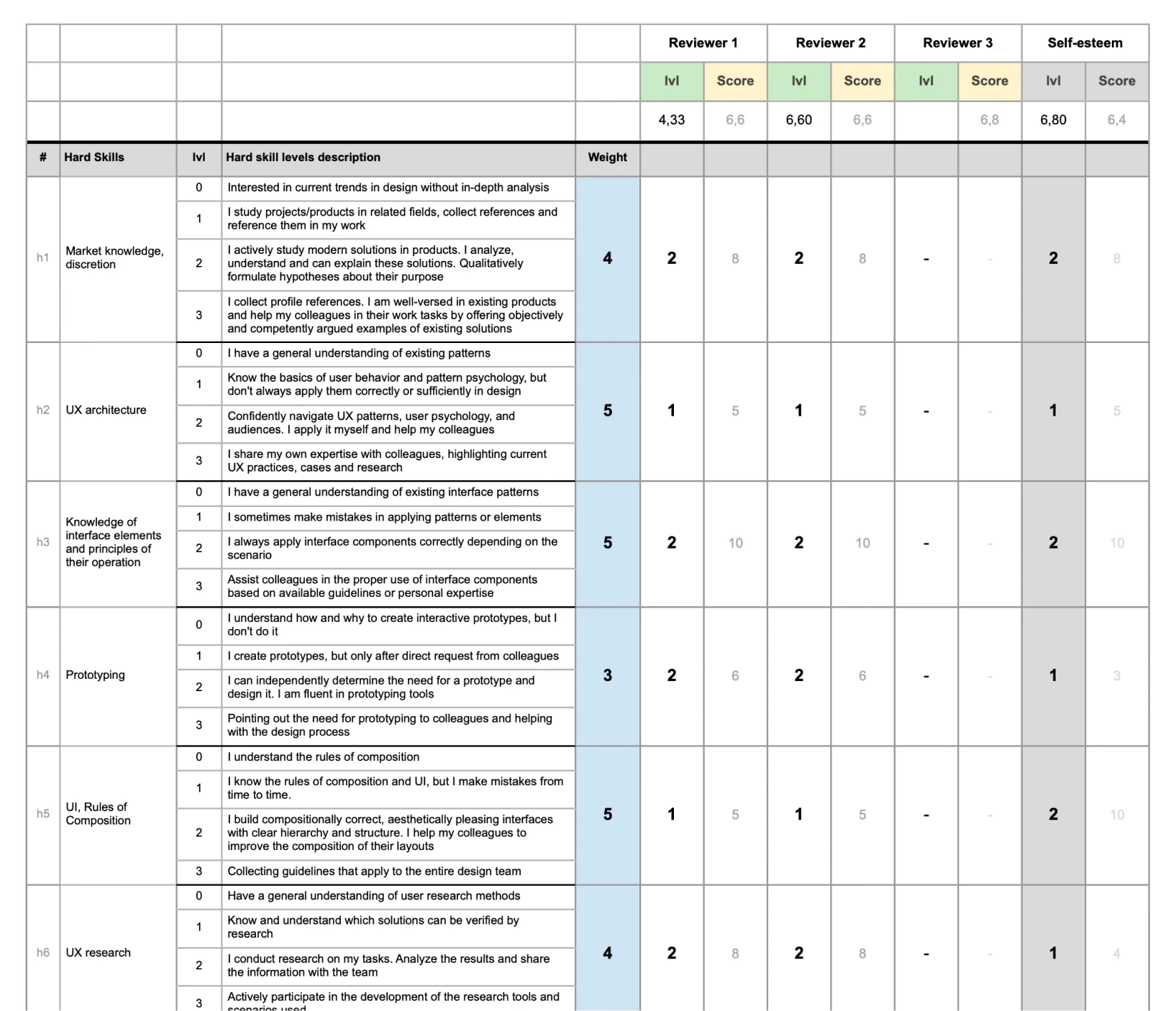
competence Matrix, hard skills section
competence Matrix, hard skills section
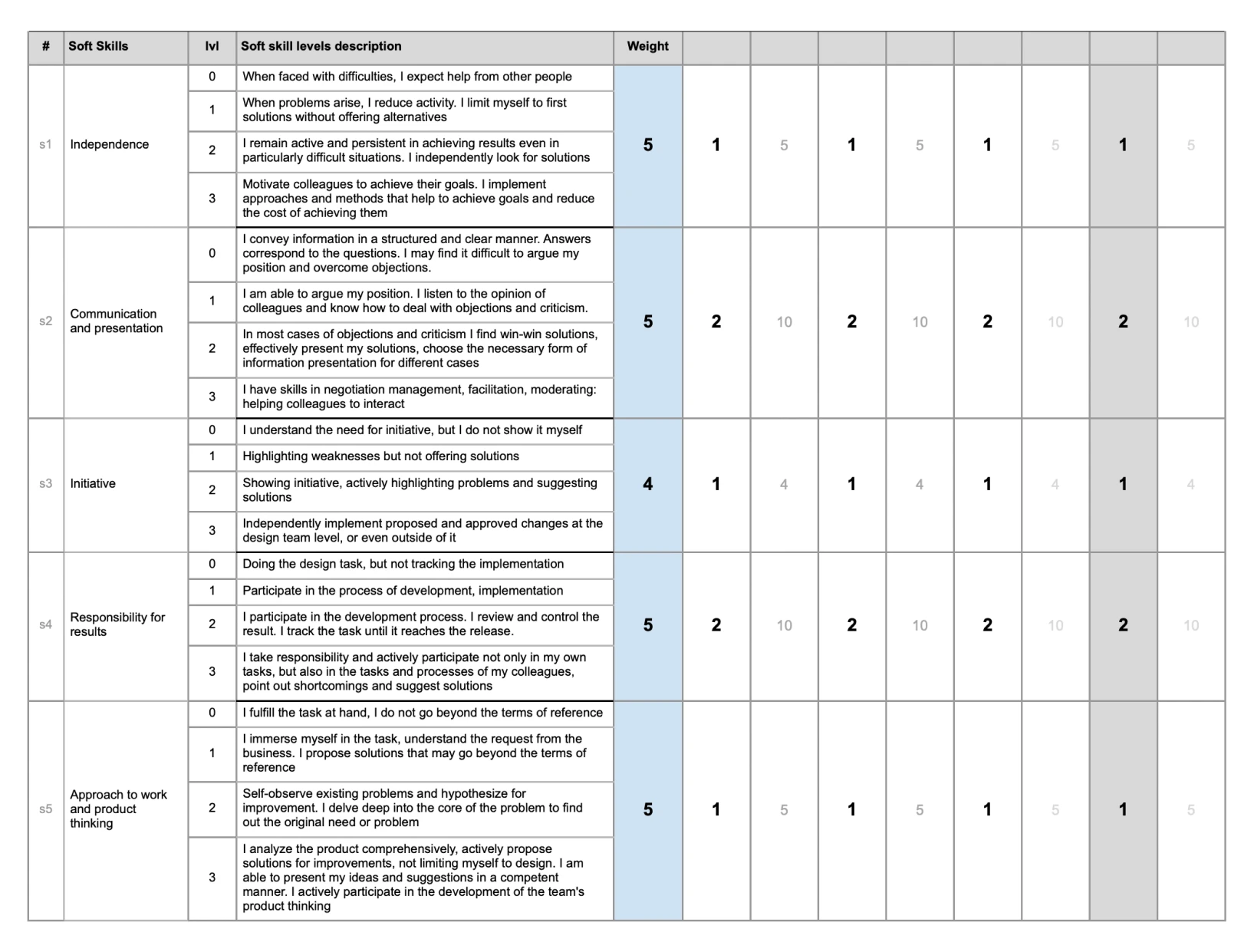
competence Matrix, soft skills section
competence Matrix, soft skills section
Diverse Perspectives
Diverse Perspectives
For medium and large teams multiple reviewers approach can be used with high efficiency. While some reviewers, like project managers, can’t assess design hard skills but can definitely evaluate soft skills. We simply skip the hard skills section for them to keep results relevant.
Self-assessment is completed by the designer being evaluated, and they can’t see their score until they submit their own. This captures the designer’s perspective and aligns expectations with reality.
Finally, multiple independent scores provide the fullest possible picture with maximum objectivity. With this approach, we get fewer questions, less arguing, less stress, and a smooth, transparent evaluation process.
For medium and large teams multiple reviewers approach can be used with high efficiency. While some reviewers, like project managers, can’t assess design hard skills but can definitely evaluate soft skills. We simply skip the hard skills section for them to keep results relevant.
Self-assessment is completed by the designer being evaluated, and they can’t see their score until they submit their own. This captures the designer’s perspective and aligns expectations with reality.
Finally, multiple independent scores provide the fullest possible picture with maximum objectivity. With this approach, we get fewer questions, less arguing, less stress, and a smooth, transparent evaluation process.
grades
grades
The best practice is to tailor grade matrix to company specifics.
Grade levels should also be adapted and company-specific. For defining the levels, the best approach is to describe specific examples for each, providing clarity for both the design team and management.
Grade levels should also be adapted and company-specific. For defining the levels, the best approach is to describe specific examples for each, providing clarity for both the design team and management.
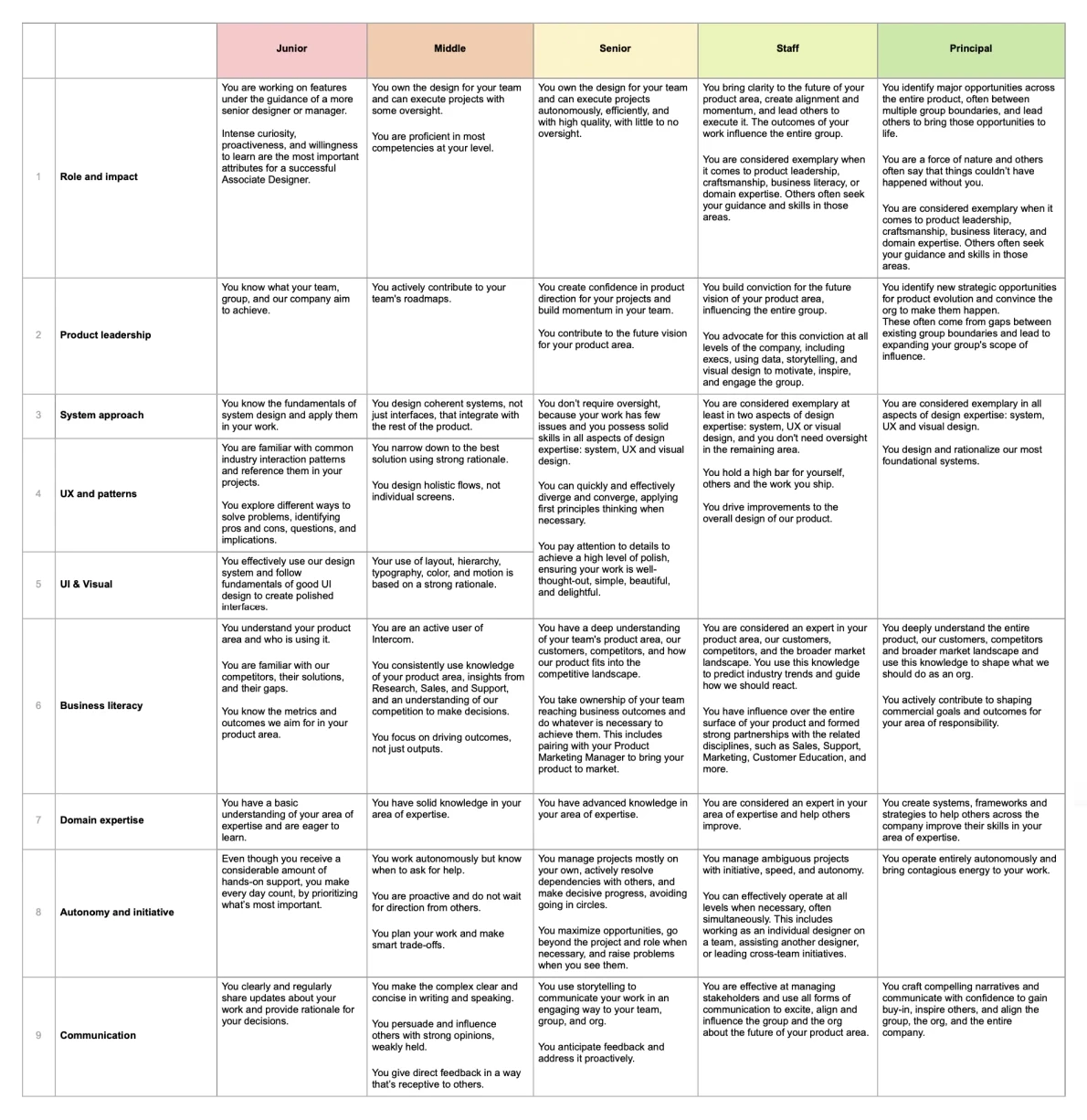
To define and set levels, describe specific examples for each level. This provides clarity for both designers and management.
Most skills remain consistent across teams and companies, but roles and levels differ significantly from team to team.
Levels must reflect the actual impact within each specific team, whereas the reverse approach, adapting the reality to the existing levels matrix, is easier but yields lower business efficiency, simple busywork and blind rule-following.
To define and set levels, describe specific examples for each level. This provides clarity for both designers and management.
Most skills remain consistent across teams and companies, but roles and levels differ significantly from team to team.
Levels must reflect the actual impact within each specific team, whereas the reverse approach, adapting the reality to the existing levels matrix, is easier but yields lower business efficiency, simple busywork and blind rule-following.
Grade matrix example
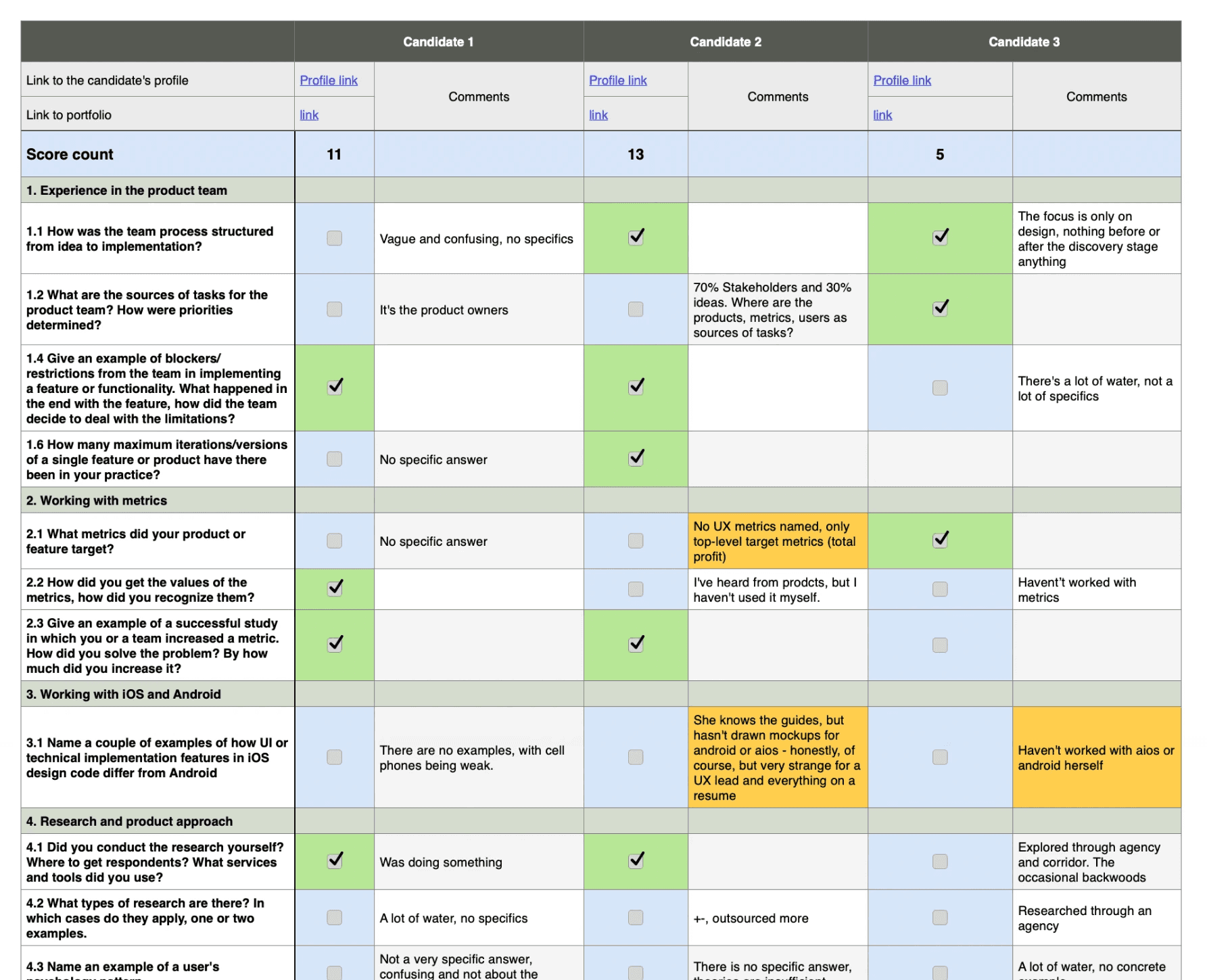
interview scorecard example
Scorecard
Scorecard
Same as any other quantitative measuring approach, the hiring process can also rely on numbers.
Same as any other quantitative measuring approach, the hiring process can also rely on numbers.
The interview scorecard approach can be surprisingly revealing: feelings and memory often contradict the facts and numbers.
More importantly, it provides clarity and helps make the choice easier. You no longer need to replay interviews in your memory again and again, trying to reach the right decision.
Moreover, this approach ensures consistency. All candidates are evaluated under equal conditions with exactly the same questions. Otherwise, comparing skills becomes a struggle. If you’re not using this approach, you should definitely try it.
The interview scorecard approach can be surprisingly revealing: feelings and memory often contradict the facts and numbers.
More importantly, it provides clarity and helps make the choice easier. You no longer need to replay interviews in your memory again and again, trying to reach the right decision.
Moreover, this approach ensures consistency. All candidates are evaluated under equal conditions with exactly the same questions. Otherwise, comparing skills becomes a struggle. If you’re not using this approach, you should definitely try it.
interview scorecard example
and more
and more
There are many more methods, approaches, and tools I’d be happy to share. Each team has its own challenges, goals, and specifics. The key to managing a design team is adaptivity – you should select tools and methods that work well for that specific team and business. This solves real problems, not busywork just because "that's how it's done."
There are many more methods, approaches, and tools I’d be happy to share. Each team has its own challenges, goals, and specifics. The key to managing a design team is adaptivity – you should select tools and methods that work well for that specific team and business. This solves real problems, not busywork just because "that's how it's done."